
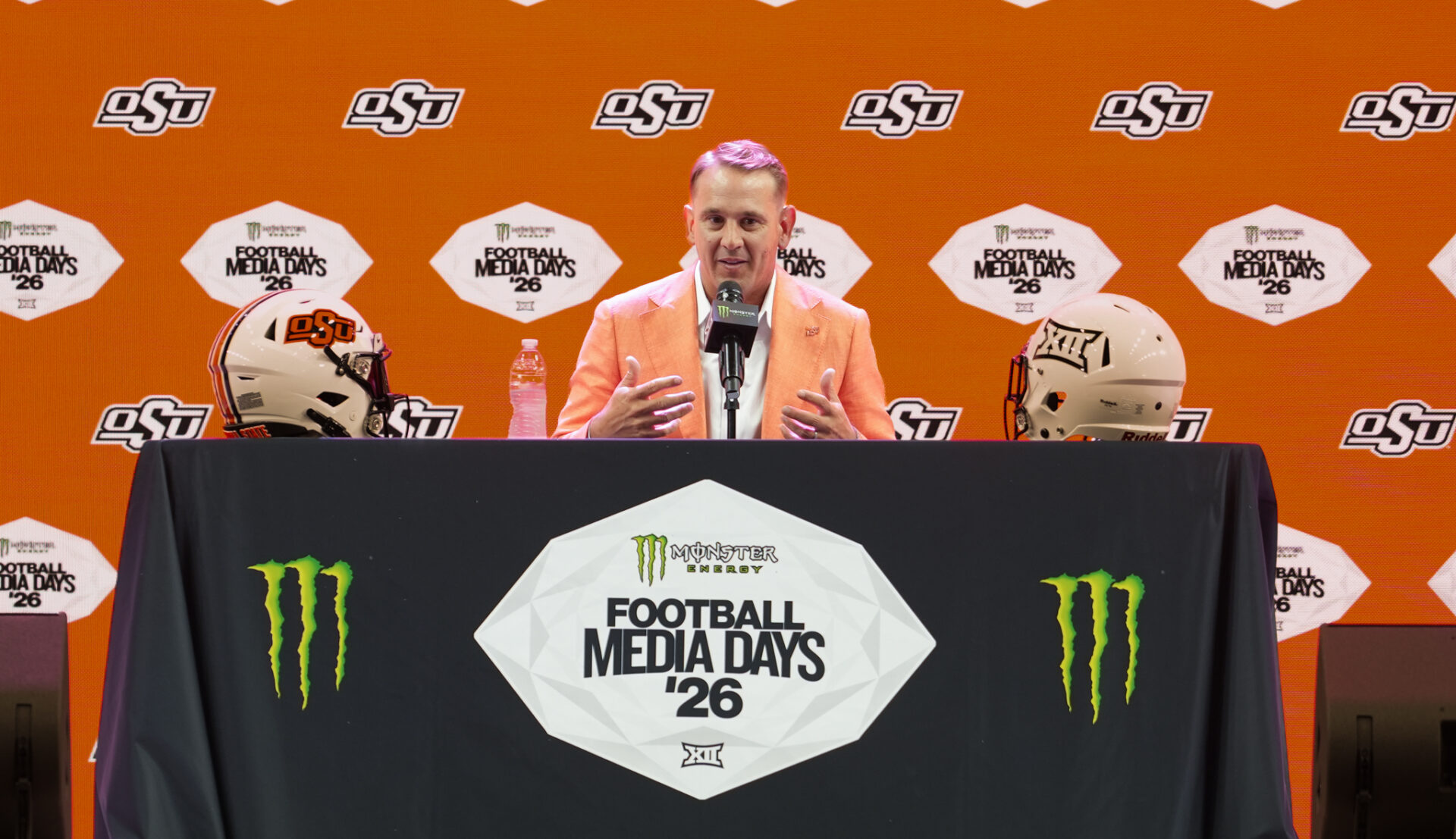
FRISCO, Texas — Eric Morris understands the expectations that come with leading Oklahoma State. He also knows restoring a program isn’t something that happens overnight.
Speaking Thursday at Big 12 Football Media Days, Morris reflected on his first several months in Stillwater, calling the transition both fast-paced and rewarding as he prepares for his debut season with the Cowboys.
Morris opened by thanking Oklahoma State President Jim Hess and Athletic Director Chad Weiberg for trusting him with one of the conference’s most recognizable programs. He said the opportunity appealed to him professionally and personally, describing Stillwater as the kind of close-knit community where he and his family wanted to put down roots.
“I’m from a small town in West Texas,” Morris said. “Stillwater felt like the right place to raise my family.”
The first-year coach inherits a program that endured a difficult 2025 campaign, finishing 3-9 overall and 1-8 in Big 12 play. Despite the recent struggles, Morris said his own memories of Oklahoma State remain tied to the program’s sustained success under former coach Mike Gundy, when Boone Pickens Stadium was one of the conference’s toughest venues and the Cowboys regularly competed for championships.
That contrast became evident as Morris settled into his new role.
He said many returning players had never experienced the feeling of winning consistently in conference play, making confidence and culture-building immediate priorities.
Rather than simply installing new schemes, Morris focused on resetting expectations throughout the program. He brought much of his coaching and support staff from North Texas, including his strength staff, believing familiarity with his standards would help accelerate the transition. Oklahoma State also added 19 transfers from North Texas, players already familiar with his system and daily expectations.
“The biggest challenge wasn’t teaching football,” Morris said. “It was getting players to believe in themselves again.”
Morris credited the offseason strength program as one of the cornerstones for establishing accountability while rebuilding the team’s confidence.
Although known for his high-powered offenses, Morris pointed to defense as one of the biggest reasons for North Texas’ success last season. He praised defensive coordinator Skyler Cassity and special teams coordinator Drew Svoboda, saying complementary football helped the Mean Green win games beyond offensive production.
That philosophy is carrying over to Stillwater.
Morris highlighted defensive lineman Jaleel Johnson as an All-Big 12 caliber player with NFL potential and pointed to experienced contributors across the defensive front, linebacker corps and secondary. He noted Oklahoma State intentionally targeted experienced players through the transfer portal, assembling one of the nation’s most seasoned rosters in terms of returning collegiate snaps.
“Our goal was to bring in players who have played a lot of football,” Morris said. “Experience matters.”
Building chemistry among so many newcomers has been another major emphasis.
Morris said team bonding has gone beyond practices and meetings, incorporating shared meals, recreational outings and activities designed to encourage players from different backgrounds to build relationships. During his first team meeting, he instructed players to sit next to teammates they didn’t know, reinforcing that there would be no separation between returning Cowboys and incoming transfers.
“It’s not about North Texas guys or Oklahoma State guys,” Morris said. “It’s about Oklahoma State.”
Morris also addressed the changing landscape of college athletics, acknowledging the transfer portal and NIL have transformed roster management. While he admitted losing players at previous stops could be frustrating, he said helping athletes improve their opportunities remains one of the most rewarding parts of coaching.
Despite the business side of modern college football, Morris said relationships with players continue to drive his passion for coaching, whether celebrating academic progress or watching athletes grow both on and off the field.
Looking ahead, Morris said the coaching staff is using July to recharge before fall camp begins. Oklahoma State’s preseason schedule will be unusually short because of the academic calendar, giving the Cowboys only eight days of training camp before classes begin.
Even with limited practice time, Morris expressed confidence because of the work completed during spring practice and summer workouts.
He also acknowledged the standard established by Gundy, whose 20-year tenure included a Big 12 championship, multiple double-digit win seasons and one of the most successful eras in school history.
“The bar has been set high,” Morris said. “As competitors, that’s what you’re chasing.”
As Oklahoma State enters a new chapter, Morris believes restoring the Cowboys begins with culture, trust and daily consistency. Whether that translates into immediate results in a competitive Big 12 remains to be seen, but his message entering Year 1 is clear: rebuild confidence first, and the wins can follow.